
How to Become a Custom Home Builder
Gain hands-on experience working for a small-scale custom home builder or general contractor, often 1 to 3 years before taking on projects of your own.
Learn your state and local licensing requirements, including any required exams, documented experience, and supervisory qualifications.
Become highly skilled at reading construction plans and understanding the building codes that govern residential construction.
Master every phase of the homebuilding process so you understand trade sequencing, subcontractor requirements, inspections, and jobsite coordination.
Develop strong project management skills, including budgeting, cost control, cash flow, scheduling, contracts, and client communication.
TL;DR
Upland Homes brings more than 20 years of experience as an award-winning custom home builder, including a 2025 Pinnacle Award (HBASC). Whether you're starting part-time or diving into custom home building full-time, we’ll explain what to learn first, which mistakes to avoid, and how to build a solid foundation for your business. Give us ten minutes, and you’ll understand the field experience, technical knowledge, project management skills, and client leadership required to become a successful custom home builder.

Management: What a Custom Home Builder Actually Does
In 2026, the primary role of a custom home builder is to turn a homeowner’s vision into a finished home while managing every detail of the construction process. You’ll coordinate architects, designers, site supervisors, subcontractors, specialty trades, suppliers, and inspectors while keeping the project on schedule, on budget, and moving in the right sequence.
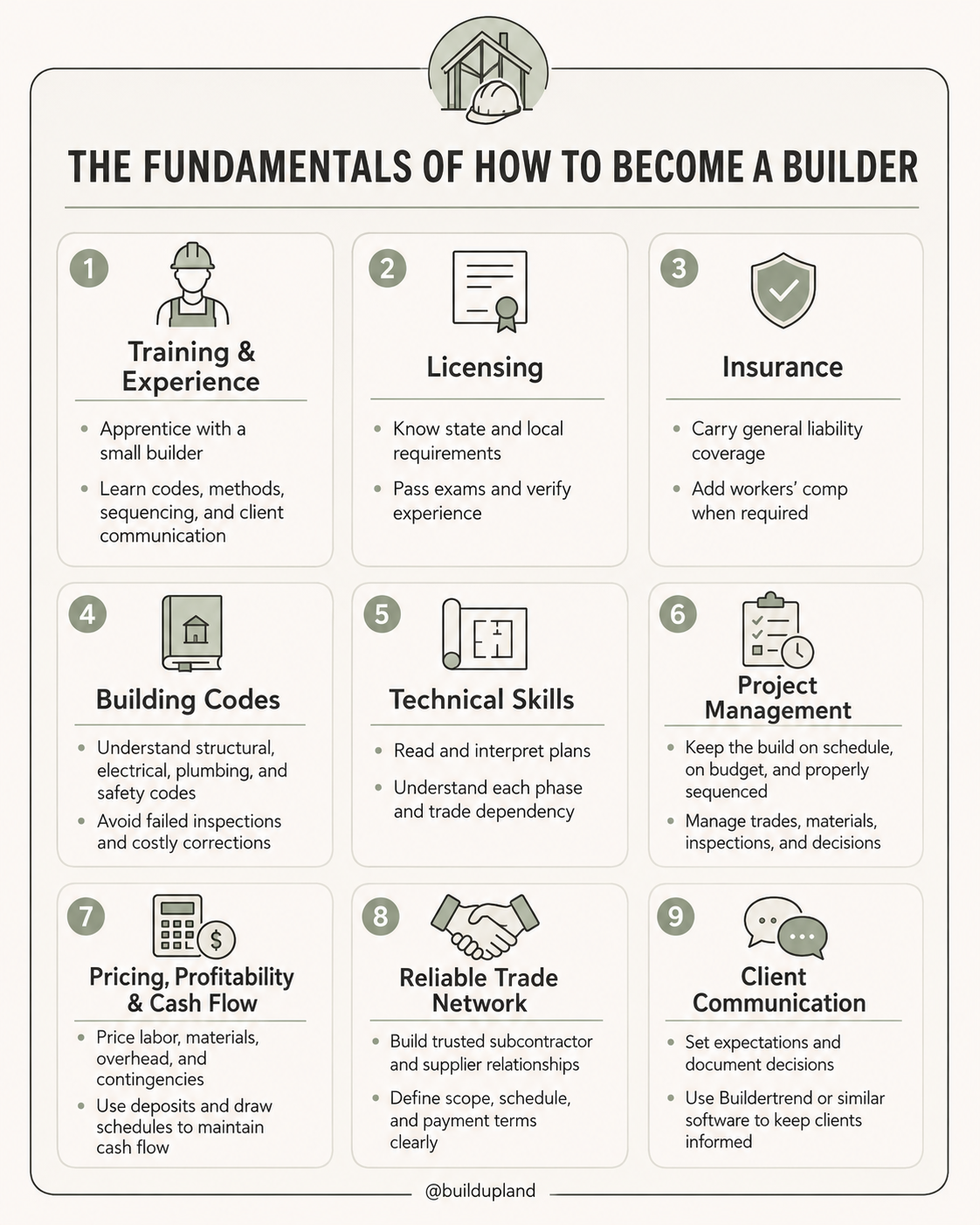
The Fundamentals of How to Become a Builder
Training and Experience
Start by finding a home builder or general contractor who does excellent residential new construction projects but is a small-scale builder. Yes, you might make less money for a couple of years, but you'll gain invaluable proximity to the builder. Echoed by custom home builders within Reddit’s r/homebuilding community, you'll learn first-hand about building codes, the latest construction methods, client communication, and trade sequencing (which we’ll talk more about in-depth). Every market has experienced custom home builders who aren't the big guys but consistently build beautiful custom homes. Your hands-on training and experience as an apprentice give you operational knowledge of custom home building that you cannot learn from a textbook, course, or jobsite observation. Plus, you'll have the practical foundation you’ll need when it’s time to pursue your contractor’s license.
Licensing
Licensing requirements vary by state or local requirements. Before you take on custom home projects, you need to know what licenses, experience, exams, and registrations are required where you plan to build. The licensing process is designed to verify your knowledge of construction practices, building codes, business regulations, and safety requirements. Contractor license requirements shape how homes are permitted, built, and inspected. Working without the proper license can lead to fines, delays, or prevent you from legally taking on a project.
Insurance
Custom home builders typically carry general liability insurance, and depending on state requirements and the size of the company, workers’ compensation coverage may also be required. These policies help protect your business from the financial consequences of accidents, injuries, and property damage during construction. Proper insurance also gives clients confidence that they’re working with a professional builder.
Building Codes
You need to understand the building codes that apply in your area and make sure every phase of construction meets them. Building codes set the minimum standards for how a home must be built, including everything from structural systems and electrical work to plumbing, energy efficiency, fire safety, and more. Custom builders stay current with code requirements to avoid failing inspections, costly corrections, and unnecessary project delays.
Technical Skills and Operational Knowledge
Beyond building codes, become known as a plan master who is extremely skilled at reading and interpreting construction plans. Take time to learn every phase required to build a house and why each one matters, from demolition, grading, trenching, footings, and foundations to framing, glazing, roofing, mechanical systems, insulation, drywall, and finishes. More importantly, learn how those phases connect and depend on one another. A strong custom home builder can look at a set of plans, anticipate what each trade will need, and sequence the work so the project keeps moving without costly mistakes or delays.
Project Management
If there’s one skill that will make or break a custom home builder, it’s project management. You’ll keep the build on schedule, on budget, and properly sequenced because if you don’t, delays compound, costs rise, trades get out of sync, and client confidence starts to erode. To stand out, learn to manage subcontractors and trades, track costs, order materials, schedule inspections, and address problems quickly and calmly when things change. Strong builders know where the money is going, who needs to be on site next, how to communicate with all parties, especially the client, and what decisions must be made to keep the project on schedule.
Construction Pricing, Profitability, and Cash Flow
Learning how to price a custom home is both a science and an art. You have to account for materials, labor, subcontractors, insurance, overhead, and the cost fluctuations and unforeseen conditions that come with construction. Just as important, you need to manage cash flow because expenses often come due before client payments arrive. Clear contracts, deposits, and draw schedules help keep enough cash available to pay bills and keep the project moving.
Build a Reliable Trade Network
Your success as a custom home builder also depends heavily on reliable subcontractors and suppliers who meet your standards and deliver on schedule. Clearly define their scope of work, schedule, and payment terms from the start. Strong trade relationships lead to smoother communication, faster problem-solving, consistent quality, and fewer delays so you encourage client confidence.
Client Communication and Relationship Management.
Clients need clear, consistent communication about budgets, schedules, selections, change orders, and anything that could affect the project. Document decisions, set expectations early, and use project management software like Buildertrend to keep communication, updates, and approvals organized. Your communication and availability builds trust, keeps decisions moving, and makes a long, complex project feel more manageable for the homeowner.
The Skills That Matter Most
Custom home builders start by building competence in three arenas: 1) preconstruction, 2) trade coordination, and 3) client leadership. Most budget overruns begin long before the first shovel hits the ground. Strong builders learn to think like planners and master the homebuilding process.
1) Preconstruction discipline
Before construction begins, a custom builder will carefully evaluate the site and confirm access, utilities, drainage, setbacks, and other constraints. After identifying potential issues, you'll translate the plan set. This is the process of creating construction drawings with specifications into a buildable scope of work, including defined trade scopes, realistic allowances, and a schedule with clear sequencing and milestones. Early ordering of long-lead materials, combined with consistent adherence to that schedule, creates a structure trades can actually follow. As a custom builder, this is how you'll protect the budget, preserve momentum, and set the project up for a smoother build from day one.

2) Trade coordination and jobsite control
In order to effectively coordinate your jobsite, it's vital to understand how each trade affects the next. Custom home building requires tight sequencing. As the builder, you'll keep the project moving by coordinating labor, deliveries, inspections, and work quality across phases. You'll manage clean handoffs between trades so work is not duplicated, damaged, or undone, while protecting the job site and verifying finishes at every stage. A strong builder knows what to review before each inspection so the project stays on schedule.

The Mistakes That Cost Builders the Most
As you learn how to become a builder, you'll need to avoid costly mistakes. When you’re a new builder, you rarely fail because you cannot build. It's the failure to manage your build that causes many to quit. Here are the common traps inexperienced custom builders should avoid:
Underbidding to “win” the project and hoping it works out later
Starting without a complete plan set or clear specifications
Allowing selections to lag behind the schedule until everything becomes rushed
Not ordering long-lead items early, especially windows, specialty fixtures, and appliances
Failing to document change orders, which is the fastest way to lose margin and goodwill
Calling inspections before work is complete, which creates delays and reinspection fees
Rushing exterior concrete, only to have heavy equipment damage it during the final stretch
As you're learning how to become a successful custom home builder, pay careful attention to the possible chain reactions for any mistake. One missed detail can affect multiple trades, push lead times, and force rushed decisions later, which is when quality slips. Your mistakes won't just hurt the budget; they'll put the schedule, craftsmanship, and client experience at risk.
How to Mitigate Mistakes
You mitigate mistakes by running a disciplined preconstruction process, documenting decisions clearly, sequencing trades correctly, and verifying each phase before the next one begins.
Building a Business Plan
Once you know how to become a home builder it's time to create your business plan. You'll want to choose your operating model and build your systems around that structure so projects run predictably. Make sure you provide clear process documents for your trade network: scopes, allowances, change orders, weekly updates, payment schedules tied to milestones, and a closeout checklist. Above all, price your work with accuracy and margin because underpricing creates risk for the client and your build.
How to Become a Home Builder
If you want to become a custom home builder, start with smaller projects before taking on complex ones. You’ll need patience and real-world experience. With time, you’ll build a strong custom home portfolio and serve more clients.
If you’re interested in building with Upland Homes call (864) 646-7660, email at hello@buildupland.com or click Contact.
3) Client leadership
Arguably the most important skill you'll need as a custom home builder is client leadership. The goal is to make the custom home building process easy to understand for your homeowner. The result of upfront and continuous communication is trust. That means translating construction complexity into clear decisions, documenting every selection and change, and providing weekly updates. Addressing revisions quickly, clearly, and without emotion keeps the project moving with alignment and momentum.

CUSTOM HOME BUILDER PROCESS
Discover
01
The first step is to take time to truly understand your client’s vision and the way they want to live. Through thoughtful conversations, in-person meetings, and site visits, you’ll learn the story behind your client’s project, where to build, and the details that matter most. Whether reviewing plans or exploring inspiration imagery together, you’re building trust so your client’s vision starts to take shape.

Plan
02
With a clear vision in place, the planning phase brings your client’s home to life on paper. Detailed drawings, curated selections, and approved permits all come together through your seamless, guided process. With transparency at every step, you’ll want to ensure your client’s home design and craftsmanship are perfectly aligned, setting the stage for a build defined by confidence and clarity. Below, explore the key steps and decisions that come together during the planning phase.
-
Through detailed site evaluations, you’ll manage surveys, septic permitting, and setbacks to ensure your client’s home is designed with precision and positioned beautifully within its landscape.
-
You’ll collaborate closely with architects to design floor plans and elevations, ensuring every space reflects your client’s vision and functions seamlessly for the way they want to live.
-
From finishes to fixtures, you’ll partner with an interior designer to curate selections that bring texture, tone, and personality to each space.
-
Using the finalized plans and design selections, you’ll develop detailed scopes of work and gather quotes from trusted vendors and trade partners. This process allows you to create a comprehensive, transparent budget that aligns with your client’s vision before construction begins.
-
Finally, you’ll coordinate all necessary neighborhood approvals and building permits, managing submissions and communications to keep your client’s project on track and ready for construction.
Build
03
Once construction begins, your client’s project is guided by your dedicated project manager who oversees every detail from start to finish. You’ll give the homeowner weekly updates and calls to keep them informed, while you use specialized homebuilding software to provide full transparency into schedules, selections, and progress. This combination of hands-on management and real-time insight ensures your client’s home is built efficiently, thoughtfully, and exactly as envisioned.
Beyond the Build
04